Pages

Showing posts with label News. Show all posts

Tuesday, May 10, 2011

Women’s Facial Expression


Yaya Sukaya demonstrated his expertise in managing space and perspective.

Teks and Photo by argus firmansyah

Women’s faces in various styles, forms, expression and having a close-up dimension on canvas seemed to be telling us a story.  There is a mystical ambience in the faces of the women appearing in various points of view.  Happiness, sadness, loneliness, cheer, hope, sadness, confusion, and other emotions seemed to be expressed to the maximum.   

On the other corner there is an installation. A prototype of a stage that is standing upright at the cat walk of models. There is only one complete figure, a nude figure that wafted out in the dark. Only a little light shone on that figure. While the others, are merely heads with frail and brittle faces. 

The dilemmatic nuance of the paintings sneaked in quietly among the boisterous crowd  visiting the opening of  Yaya Sukaya’s solo exhibition entitled Close Up in hall C, Indonesian National Gallery (Galeri Nasional Indonesia), Central Jakarta, Thursday (12/3) evening.

For the first time Yaya Sukaya held a solo exhibition in the National Gallery. It was officiated by Amir Sidharta, a renowned curator and art critic. “ Yaya Sukaya does not use objects that has become icons, a popular practice among other visual artists. Hopefully this will become a new perspective in our current and future visual art world,” said Amir.

The phrase close up is generally used in photography techniques as well as picture and voice recording, exposing objects from a near distance without becoming too extreme. Presenting close up faces of women, Sukaya tries to elaborate his concern for contem-porary urban women and teenagers.

Chandra Johan, the exhibition curator, said that Yaya Sukaya’s paintings show his expertise in managing space and perspective. “Those faces represent the current life, with all shapes/forms responding to the life they are celebrating. Another essential thing shown by Yaya, is his strong spirit in creating his art,” said Chandra Johan.

Close Up is the representation of Yaya Sukaya’s maturity as an artist. His strong back-ground in interior design shown in the form of accurate calculation of line compo-sition, field, color, dimension as well as the quality of expression highlighted in his paintings and installations. 

“In this exhibition all I wanted was to open up a discourse. Even collectors will not be able to tell whether it is a modern or postmodern work,” said Yaya Sukaya. ***
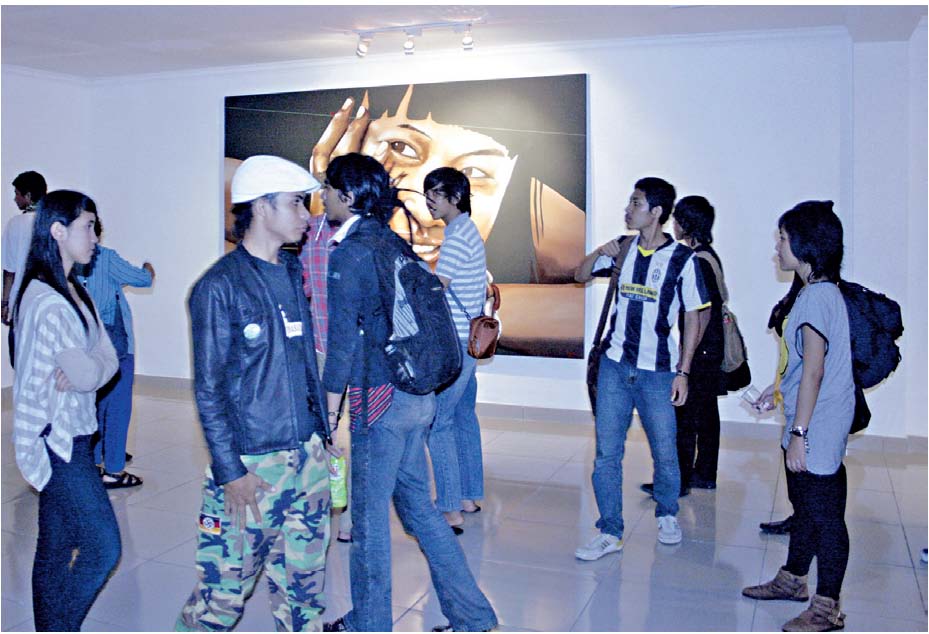


Tittle: CLOSE UP
Artist: Yaya Sukaya
Curator: Chandra Johan
Place: Gedung C, Indonesia National Gallery, Jakarta
Time: 12 – 23 Maret 2009

source: arti mag 15th edition, Mei 2009
READMORE....

Thursday, April 21, 2011

Reverberation Time: Solo Exhibition Alibasyah Abas

Abas work
Senior painter Abas Alibasyah (82 years), held a solo exhibition namely "Reverberation Time", opened on Thursday, November 4, 2010, at 19:00, by Syakieb A. Sungkar (art collector) at the National Gallery of Indonesia, Jl. Medan Merdeka Tmur 14, Jakarta. Exhibition be held until November 14, organized by the ARMA (Agung Rai Museum of Art), Bali, ASPI (Association of Indonesian Art lovers, and the National Gallery of Indonesia. Please note that Abas Alibasyah who was once the rector of the High School of Fine Arts "Asri" Yogyakarta, and he is one of the founders of the National Gallery of Indonesia.

This exhibition curated by  Rifky Effendy. Along with the exhibition launched the book "Echoes of Time The paintings Abas", 180 pages, the composition Agus Dermawan T. Paintings include creation held in the 1960s until 2010. The exhibition also displayed various masks archipelago that inspired the paintings Abas.

Historical Overview Abas

Abas Alibasyah, or Alibasyah Natapriyatna, born in Purwakarta, West Java 1926. But because of administrative mistakes in the days of struggle, he had written was born 1928. For ease of life, in which he continues to use this mistaken. He is the son of a working ambtenaar Water Bureau.

At the time he joined the Japanese Bunka Keimin Sidhoso, associations of Indonesian arts era of Japanese rule. In 1949 he went to Yogyakarta, Taman Siswa active in college, and joined the People's Artist-led studio Hendra Gunawan. In this city he entered the ASRI (Academy of Fine Arts of Indonesia). In 1956 Abas was appointed as a lecturer there. Outside the ASRI he also became a lecturer at the Teachers' Training College (Teacher Training Institute of Education Sciences) and at Gadjah Mada University majoring in architecture. Long before he taught art at various high schools. Abas became Rector of the High School of Fine Arts of Indonesia "Asri" until 1975. He was also the Secretary-General Director of Culture and as Superintendent of Culture.

Abas is known as freedom fighters. Become the Students' Army, and join the ranks of the leadership AH. Nasution Siliwangi Division that operates in South Bandung to Garut, even in Yogyakarta in 1947 and the Clash Clash I-II-1948.

Many awards have been received Abas Alibasyah, both as artists and as a fighter. Here are some that are listed.

Award as an artist
- In 1967, received the graphic arts scholarship to The Hague, Netherlands.
- In 1970, received the "Cultural Award Scheme" from the Australian government.
- In 1984, 1 December, received the "I Gusti Nyoman Lempad Prize" from Studio Dewata Indonesia, Yogyakarta, signed Made Sudibya, Made Jana and Gunarsa.
- In 1985, 4 May, received a charter "Art Prize" for the field of fine arts from the Ministry of Education and Culture, Professor. Dr. Nugroho Notosusanto.
- In 1998, 15 October, received a charter service culture and art from the Minister of Tourism, Art and Culture of the Republic of Indonesia, Marzuki Usman.
- In 2002, 18 August, received the charter mark of honor "Satyalancana Culture" from the President of the Republic of Indonesia, Megawati Sukarnoputri.

Award as fighter
- In 1958, August 17, 1958, received a charter "Event Satyalantjana Second War of Independence" from the Ministry of Defence of the Republic of Indonesia, was carried out.
- In 1958, August 17, 1958, received a charter "Satyalantjana Event War of Independence to One", the Minister of Defence of the Republic of Indonesia, was carried out.
- In 1958, 10 November 1958, received the "Alert Service Heroes" from the President, Commander in Chief of the Armed Forces of the Republic of Indonesia, Sukarno.
- In 1958, 10 November, accepted the charter "Satyalantjana Bhakti" from the Ministry of Defence of the Republic of Indonesia, was carried out.
- In 1959, 29 January, received a charter "Military Operations Satyalantjana Movement I" from the Ministry of Defence of the Republic of Indonesia, was carried out.
- In 1967, 10 November, accepted the charter "Satyalantjana enforcer" of the security minister, Suharto, General military.
- In 1981, 30 October, received an honorary degree "Veterans Independence fighters" from the Ministry of Defense and Security / Commander of the Armed Forces / Deputy Commander of the Armed Forces, Sudomo, Admiral TNI.
- In 1989, 2 May, received a mark of honor "Satyalencana Karya Satya Level II" from the President of the Republic of Indonesia, Suharto.
READMORE....

Tuesday, April 19, 2011

The Evolution of Fish and Fat Statue

The transformation of visual shapes into paintings and into a series of statues depicting urban life.

How can a fish swim at one time and ends up a carcass at another? Joko ”Gundul” Sulistio-no depicted his own version of fish evolution phases through a series of paintings called ”Evolusi I” to 1 Evolusi V”. He did not adopt the Darwinian way, though. Instead, he presented an evolution of the fish’s body parts. In the series of paintings made from mixed paint materials on canvas, he started by depicting the head of a fish who watched a little blue fish swimming inside a glass jar in front of it. The fish’s head was complete with a set of eyes, fins, gills, mouths and thick scales. The fish’s head seemed to be observing the little creature swimming lightly around the jar seriously.

In ”Evolusi II”, Joko depicted a fish without tail which was sup-ported by a single beam. The fin was stabbed onto the fish’s back. On its belly was a spinning propeller like that which is used to move boats at sea or on the rivers. Joko seemed to be ”transplanting” a electrical propeller mechanism to a fish’s body. In this painting, the little fish in the glass jar was standing by below it, as if it was ready to swim.

“Evolusi III” then depicted a fish with a fan propeller tail. It was supported by two beams, enabling it to stand upright. Little fish were swimming around it. “Evolusi IV” depicted a fish being chopped by two ropes coming from above it and “Evolusi V” depicted a fish as a trade commodity. The fish was weighed and helplessly waited for someone to “co-modify” it. The co-modification separated the fish from its original habitat. Ac-cording to the exposition’s curator, Joko was describing the differences between a fish who lives free in his original habitat and a fish as a fossil.

The copper statue made by artist Putu Adi Gunawan showed figures of men and animals in various expressions. The statue titled “The Blind Man” depicted a man with a large, short body, wearing glasses and holding a cane. He was walking using his cane as guide. The statue “Kid Rock” looked more cheerful. It depicted a little child carrying a guitar on his shoulder with his father in front of him. Both were raising their hands and showed excitement and happiness, whereas “The Kiss” is a statue de-picting a kissing scene between a man and a woman.


This two-dimensional and three-dimensional art exposition clearly showed that the two ISI Yogyakarta graduates are ar-tists who keep on experimenting and creating interesting wor-ks of art.


Title of Exposition : Two Signs
Artist              : Joko Sulistiono and Putu Adi Gunawan
Curator             : Asikin Hasan
Location            : Andi’s Gallery Jakarta
Date                : Desember 10-24, 2008

TEXT AND PHOTOS ahmad nurhasim
Source: arti 13th edition, maret 2009
READMORE....

Interaction Room

By using two space mediums: inside a building and in a garden, “the spirit of interaction” was meant to trigger an interaction between the works of art, the visitors and the space itself. did it work?
Like goddesses dancing in the rain on a grassy field, the statue (Suwuk by Yani Sastra Negara) seemed to blend with the nature, as did the statue depicting a house with a person stand-ing beside it (Inside by Awan Simatupang). It was a reflection of a sentiment of realizing the meaning of a bond between someone with his residence.

Some suitcases were neglected and scattered in so many places: on the chair, on the table and even on the street. There was a crying suitcase (Frankie Menangis – Frankie Crying), a suitcase which opened and closed itself me-chanically (Long Journey), a still suitcase (Travel) which tells a particulary story, a journey, probably his owner’s life journey, through its ragged color and wrinkles on the leather. Suitcases are a loyal company to those who travel a lot. They play a very important role in travels, but they are wasted away when they are worn out. That’s not the case to Hardiman Radjab, though. The worn

suitcases full of memories were used as mediums for art.

The silent interaction was extremely obvious on artworks that are placed outdoor (in the garden). The visitors, the artwork and the space (nature) seemed to blend into each other. After the rain, where there were still tiny drops of water fall-ing from the sky, the visitors were still reluctant to explore artworks placed in the garden. Silent atmosphere graced by semiluminous lights made the “Spirit of Dance” statue by Taufan AP looked as if it was truly dancing in the garden.

Some of the artworks on display indoor maintained its in-teraction with the room, but some didn’t. The installation art “Rakyat + Biasa – Common + People” by Abdi Setiawan which featured two statues, one depicting a common per-son and another depicting a grim-looking policeman with baton on his hand, seemed to describe how common people are always suspected of being up to no good by the authority. It was a beautiful artwork, but it was bizarre when displayed in the room. Maybe, if someone was willing to go a little bit more extreme, the statue can be put in front of Erasmus Huis building or on the roadside. It may create more interaction that way.

One of the works of art that succeeded in maintaining in-teraction with indoor space is Tita Rubi’s. Cornered in the room, “Vagina Brokat – Lace Vagina” seemed to ooze an enigmatic aura of its own.

Its meaning is quite obvious. It was an installation art of a lace, shaped into a cone”, suspended from above the wall down into the floor like a mosquito net with a hole in the center as three male statues surrounded it.

Tita may have been describing the fragility of a female sex organ, as fragile as lace material, easily torn apart by men. It represents the difficulty of guarding such a fragile thing among predators.

Some interactions succeeded, some did not. However, “The Spirit of Interactions,” interactive scheme is of course worth praising for.


Name     :  The Spirit Of Interaction
Artists  :  AB Soetikno | Abdi Setiawan | Ade Art |   Amalia Radjab | Anusapati | Awan

Simatupang | Budi Santoso | Hardiman radjab | Innes Indreswari | Taufan AP | Titarubi |

Yani Maryani Sastranegara
Curator  :  Dolorosa Sinaga
Location :  Erasmus Huis Jl. HR Rasuna Said Kav 3, Kuningan Jakarta
Date     : January 14, 2009

Text and Photo by Darma Ismayanto
Source: arti 13th edition, 2009
READMORE....